Evolution of vapor–liquid interface during film boiling on sphere
For several decades, the vapor–liquid interface dynamics have been evaluated for several problems under different assumptions. The evolution of a vapor film on hot surfaces during heat transfer in substantially subcooled liquids and associated applications has also received considerable attention. Examples include cooling of highly loaded heat-generation equipment during quenching, vapor explosion, and environmental processes such as volcanic eruptions.
A theoretical model of the unsteady thermal interaction of a single hot particle with surrounding water heated to boiling point was proposed in Dombrovskii and Zaichik (2000). However, the solution presented here is only suitable for saturated and not subcooled liquids.
In Gubaidullin and Sannikov (2000), a two-phase bubble dynamics model was proposed, taking into account the non-equilibrium nature of the phase transition, and numerical modelling of heat and mass transfer processes was carried out. The thermal growth regime of a vapor bubble containing a hot particle was studied, and the influence of the non-equilibrium phase transition in the thermal and dynamic growth modes of the vapor layer was analysed. However, in this problem, a heat flux was supplied from the vapor side, thereby influencing the vapor pressure near the interface.
The solution of the boiling dynamics problem for superfluid helium, which has the highest heat transfer efficiency among all substances, on a cylindrical heater was presented in Dergunov et al. (2000). The non-equilibrium boundary condition was obtained using the method of moments of the Boltzmann kinetic equation solution for evaporation-condensation problems, assuming zero mass flux at the interface surface (Muratova and Labuntsov, 1969). Various models were used to describe the heat transfer in superfluid helium. The results of numerical solutions show that oscillatory motion modes of the interface are damped due to the viscosity of the superfluid normal component.
A similar approach was used in Grunt et al. (2019), wherein the dynamics of a vapor bubble during superfluid helium boiling on a heater surface at microgravity conditions was analysed based on the Rayleigh equation considering the mass flux from the phase interface. Empirical data on the velocity and size of the bubble at a certain point in time were used as initial data and compared with experimental data (Takada et al., 2018). The prediction obtained using the mathematical model was in reasonable agreement with the empirical data.
In Nemirovskii (2020), the solution for a spherical heater in a volume of superfluid helium was improved based on the Landau–Khalatnikov equations of two-fluid hydrodynamics, and a new equation describing the motion of the vapor–liquid interface was obtained. This equation differed significantly from the classical Rayleigh equation and included additional dissipative terms to account for the mutual influence of normal and superfluid motion. Numerical solutions showed differences in the damping rates of the interfacial surface vibrations.
Thus, the classical approach of using the Rayleigh equation to describe the dynamics of a spherical vapor–liquid interface is still relevant for oscillating and collapsing bubbles (Puzina et al., 2024). As a consequence, the experimental research has employed spherical geometry to reduce the influence of the end-heater part (Kryukov and Mednikov, 2006). Experiments have suggested the possible existence of a smooth stable vapor film on the surface of a spherical heater (Kryukov and Mednikov, 2006), which has motivated the formulation of the problem considered in this study. Some experimental results for temperature dynamics during subcooled film boiling of water was received in Yagov et al. (2015).
Despite the fact that the problem of cooling hot objects immersed in cold liquids has been studied for many years, non-equilibrium effects at the vapor–liquid interface have hardly been considered in its study. The description of such processes can no longer be carried out only by continuum methods, but must be accompanied by a molecular-kinetic approach free from the limitations on the degree of non-equilibrium. This paper represents a possible way of such conjugation.
An unsteady problem of heat and mass transfer involving the interaction of a hot ball with a liquid underheated to the saturation state (subcooled liquid) was considered (Fig. 1). A ball heater of a known radius \(R_{w}\) was immersed in a liquid with a known bath temperature \(T_{b}\) to a depth \(h\). A constant pressure \(P_{b}\) was maintained on the liquid surface. When a thermal flux \(q_{w}\) was applied, a spherical vapor film of finite size \(R_{1}\) was formed on the surface of the heater. The problem involved determining the time dependences of the characteristic parameters of the process and describing the dynamics of the vapor–liquid interface. Two types of liquids were considered, namely ordinary water, which is the most common coolant, and superfluid helium, which has excellent heat transfer characteristics. More detail problem statement and main assumptions presented in Puzina et al. (2024).
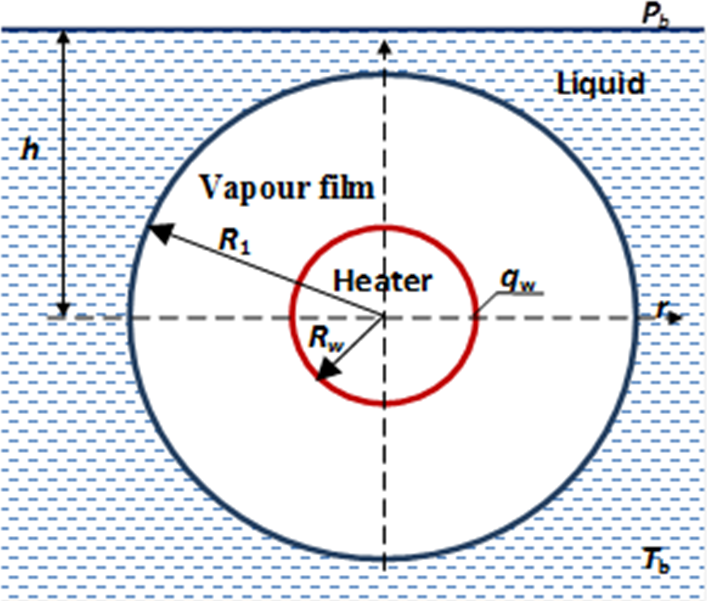
Figure 1. Schematic of the problem
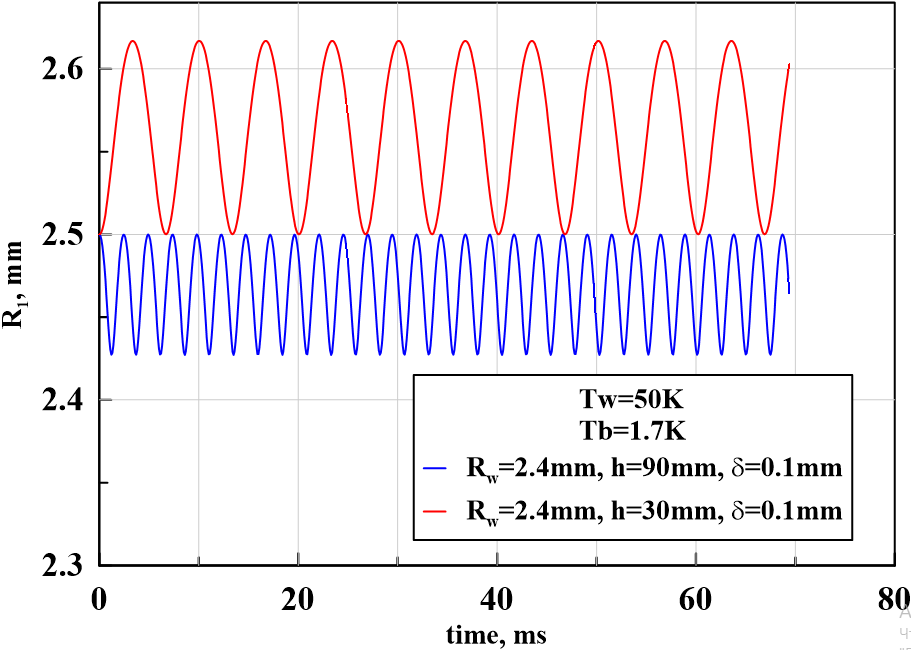
The results of vapor film radius evolution for different liquids are shown in Figs. 2 and 3. For water [Fig. 2(a)] heater radius \(R_{w} =\) 5 mm, heater temperature \(T_{w} =\) 1073 K, bath temperature \(T_{b} =\) 313 and 353 K, initial vapor film \(\delta_{0} =\) 1.5 mm, depth of heater immersion \(h =\) 100 mm. For superfluid helium [Fig. 2(b)] heater radius \(R_{w} =\) 2.4 mm, heater temperature \(T_{w} =\) 50 K, bath temperature \(T_{b} =\) 1.7 K, initial vapor film \(\delta_{0} =\) 0.1 mm, depth of immersion \(h=\) 90 and 30 mm. The vapor–liquid interface temperature was assumed to be equal to that of the bath owing to the unlimited efficiency of heat transfer in superfluid helium. Thus, \(T_{1} = T_{b}=\) 1.7 K.
 |
 |
| (a) | (b) |
Figure 2. Evolution of vapor–liquid interface vapour film radius \(R_1\): (a) water and (b) superfluid helium
 |
 |
| (a) | (b) |
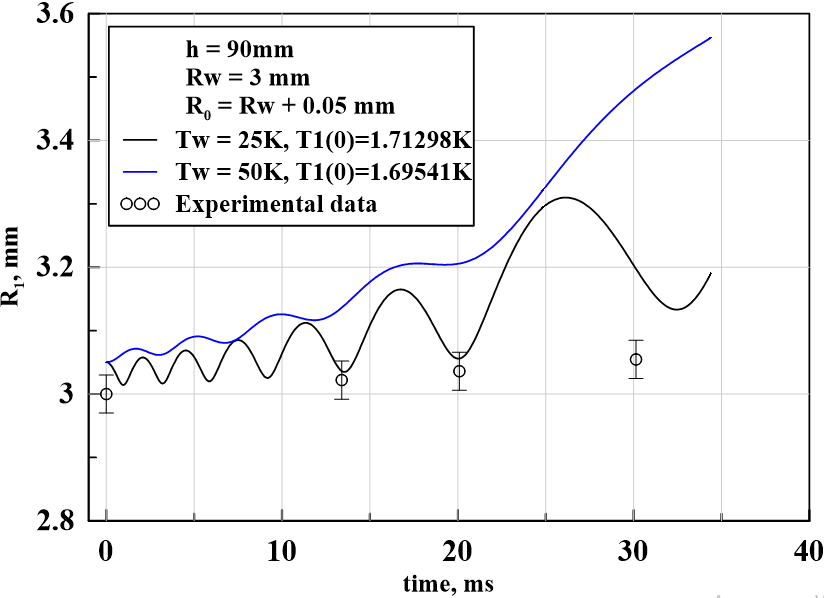
Figure 3. Evolution of liquid-vapour interface vapour film radius \(R_1\): (a) different heater temperatures \(T_{w}\) (\(R_w =\) 3 mm, \(h =\) 90 mm), assuming finite, non-zero thermal resistance of superfluid helium; and (b) different heater temperatures \(T_{w}\) (\(R_w =\) 3 mm, \(h =\) 90 mm) and experimental data (Kryukov and Mednikov, 2006)
Figure 2(a) shows that for water at \(T_{b} =\) 40°C, the vapor film (cavity) collapses (black line), and at \(T_{b} =\) 80°C, the vapor film radius remains almost constant with time (blue line). As is evident from Fig. 2(b), oscillations of the superfluid helium vapor–liquid interface are not attenuated for an extended period. As is evident from Fig. 3(a), the vapor film radius \(R_{1}\) increases with increasing amplitude of oscillations. Evidently, the experimental data are located between the results obtained using the approaches considered in this study [Fig. 3(b)].
REFERENCES
Dergunov, I.M., Kryukov, A.P., and Gorbunov, A.A. (2000) The vapor film evolution at superfluid helium boiling, J. Low Temperature, 119: 403–411.
Dombrovskii, L.A. and Zaichik, L.I. (2000) The dynamics of vapor void under conditions of thermal interaction of a hot spherical particle with ambient water, High Temperature, 38: 938–947.
Gubaidullin, A.A. and Sannikov, I.N. (2000) The dynamics and heat and mass transfer of a vapor bubble containing a hot particle, High Temperature, 43: 922–929.
Grunt, K., Lewkowicz, M., Pietrowicz, S., Takada, S., Kimura, N., and Murakami, M. (2019) Dynamics of vapour bubbles induced during the boiling of superfluid helium under microgravity conditions, Int. J. Heat Mass Transf., 134: 1073–1083.
Kryukov, A.P. and Mednikov, A.F. (2006) Experimental study of He-II boiling on a sphere, J. Appl. Mech. Tech. Phys., 47: 836–841.
Muratova, T.M. and Labuntsov, D.A. (1969) Kinetic analysis of evaporation and condensation processes, Teplofizika Vysokih Temperatur, 7: 959–967. (in Russian)
Nemirovskii, S.K. (2020) Cavity evolution and the Rayleigh–Plesset equation in superfluid helium, Phys. Rev. B, 102: 064511.
Puzina, Y.Y., Kryukov, A.P., and Levashov, V.Y. (2024) Evolution of liquid–vapour interface during film boiling on sphere, Int. J. Therm. Sci., 196: 108683.
Takada, S., Kimura, N., Pietrowicz, S., Grunt, K., Murakami, M., and Okamura, T. (2018) Visualization of He II boiling process under the microgravity condition for 4.7 s by using a drop tower experiment, Cryogenics, 89: 157–162.
Yagov, V.V., Zabirov, A.P., and Lexin, M.A. (2015) Unsteady heat transfer during subcooled film boiling, Therm. Eng., 62: 833–842.
参考文献列表
- Dergunov, I.M., Kryukov, A.P., and Gorbunov, A.A. (2000) The vapor film evolution at superfluid helium boiling, J. Low Temperature, 119: 403–411.
- Dombrovskii, L.A. and Zaichik, L.I. (2000) The dynamics of vapor void under conditions of thermal interaction of a hot spherical particle with ambient water, High Temperature, 38: 938–947.
- Gubaidullin, A.A. and Sannikov, I.N. (2000) The dynamics and heat and mass transfer of a vapor bubble containing a hot particle, High Temperature, 43: 922–929.
- Grunt, K., Lewkowicz, M., Pietrowicz, S., Takada, S., Kimura, N., and Murakami, M. (2019) Dynamics of vapour bubbles induced during the boiling of superfluid helium under microgravity conditions, Int. J. Heat Mass Transf., 134: 1073–1083.
- Kryukov, A.P. and Mednikov, A.F. (2006) Experimental study of He-II boiling on a sphere, J. Appl. Mech. Tech. Phys., 47: 836–841.
- Muratova, T.M. and Labuntsov, D.A. (1969) Kinetic analysis of evaporation and condensation processes, Teplofizika Vysokih Temperatur, 7: 959–967. (in Russian)
- Nemirovskii, S.K. (2020) Cavity evolution and the Rayleigh–Plesset equation in superfluid helium, Phys. Rev. B, 102: 064511.
- Puzina, Y.Y., Kryukov, A.P., and Levashov, V.Y. (2024) Evolution of liquid–vapour interface during film boiling on sphere, Int. J. Therm. Sci., 196: 108683.
- Takada, S., Kimura, N., Pietrowicz, S., Grunt, K., Murakami, M., and Okamura, T. (2018) Visualization of He II boiling process under the microgravity condition for 4.7 s by using a drop tower experiment, Cryogenics, 89: 157–162.
- Yagov, V.V., Zabirov, A.P., and Lexin, M.A. (2015) Unsteady heat transfer during subcooled film boiling, Therm. Eng., 62: 833–842.