Kinetic Approach to Homogeneous Nucleation at Intensive Evaporation
It has been shown in some works that vapor evaporated from the interface surface is in a metastable state where the local vapor pressure is greater than the saturated vapor pressure. That is, the degree of super-saturation (ratio of local vapor pressure to pressure to saturated vapor pressure) is more than unit and this ratio increases significantly with increasing evaporation intensity (Anisimov et al., 1970; Labuntsov and Kryukov, 1979). It is well known that under these conditions non-equilibrium first order transitions can be realized, transforming a meta-stable parent phase into a thermodynamically stable daughter phase. This transformation takes place by the formation of small clusters of molecules (or droplets) of the daughter phase from the parent phase and is referred to as homogeneous nucleation or bulk condensation processes (Kalikmanov, 2013).
The formation of these clusters or droplets can generally be realized at any distance from the interface surface and that this transition leads to a decrease in vapor number density during the condensation process and an increase in vapor temperature during the phase transformation. All these factors can influence the evaporation intensity process. As a result, the possibility of taking this process into account should be considered when studying the evaporation process.
Traditionally, the nucleation process in supersaturated media has been described using correlations of classical nucleation theory and the kinetic equation for the droplet size distribution function or system of moment equations (Hulburt and Katz, 1964; Frenclach and Harris, 1987).
These approaches are often used to describe homogeneous nucleation processes that can be realized in various technical devices, such as nozzles, thermodiffusion chambers, turboexpanders, steam turbines and others (Sidorov and Yastrebov, 2021; Hosseinizadeh et al., 2023). However, the influence of the homogeneous nucleation process on the intensity of heat and mass transfer during evaporation is poorly understood.
It should be noted that in contrast to the technical situations described above, the evaporation process has some peculiarities. Obviously, the motion of the vapor-droplet mixture and the formation of droplets during the nucleation process at evaporation can be described by continuum mechanics equations together with homogeneous nucleation equations. However, it is well known that there are some problems in formulating the boundary conditions for these equations at evaporation process (Zhakhovsky et al., 2019; Kryukov et al., 2021).
The problem of boundary condition formulation is particularly related to the fact that there is a thin non-equilibrium layer (Knudsen layer) near the evaporation surface. The length of this layer is not large from a macroscopic point of view and has a value of some lengths of the mean free path of vapor molecules, but vapor parameters can change significantly during collisions of vapor molecules with each other and with the interface surface at this layer. The “language” of continuum mechanics is not correct in this case and methods of molecular kinetic theory should be used. One of the possible approaches to the studied evaporation problem with consideration of macro-parameters transformation into Knudsen layer is a joint application of molecular kinetic theory methods with continuum mechanics equations. In this case the solution in the Knudsen layer is based on the Boltzmann kinetic equation, outside this layer the solution is based on the continuum mechanics equations (Kryukov et al., 2007).
As mentioned above, the homogeneous nucleation process can be realized at any distance from the evaporation surface including Knudsen layers. As a consequence, the approaches that consider bulk condensation during evaporation should include the possibility of calculating droplet formation and they influence on the intensity of the processes at some distance from the interface surface, including the Knudsen layer. A possible approach to modelling this situation based on the Boltzmann kinetic equation has been proposed in Kortsenshteyn et al. (2024) and Levashov et al. (2024). In Kortsenshteyn et al. (2024), the influence of bulk condensation on evaporation processes was considered on the basis of an iterative approach in which the results of the numerical solution of the Boltzmann kinetic equation were used to calculate the kinetics of bulk condensation near the evaporation surface.
In Levashov et al. (2024), the special procedure of transformation of the velocity distribution function during vapor-droplet interactions was used. The calculation of a change in the vapor distribution function as a result of its interaction with liquid particles is central to this approach. The schematical illustration of this presented in Fig. 1.
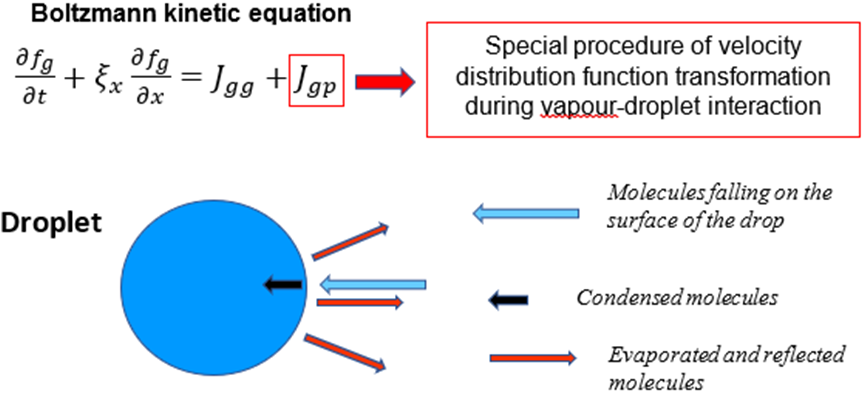
Figure 1. Schematic illustration of vapor-droplet interactions
Figure 1 illustrates that molecules, falling onto the surface of a droplet, can condense or be reflect from that surface. In addition, a fraction corresponding to evaporation can be added to the reflected molecules. To describe the change in the distribution function as a result of these processes, the collision integral \(J_{gp}\) in the Boltzman equation is replaced by the distribution function transformation procedure.
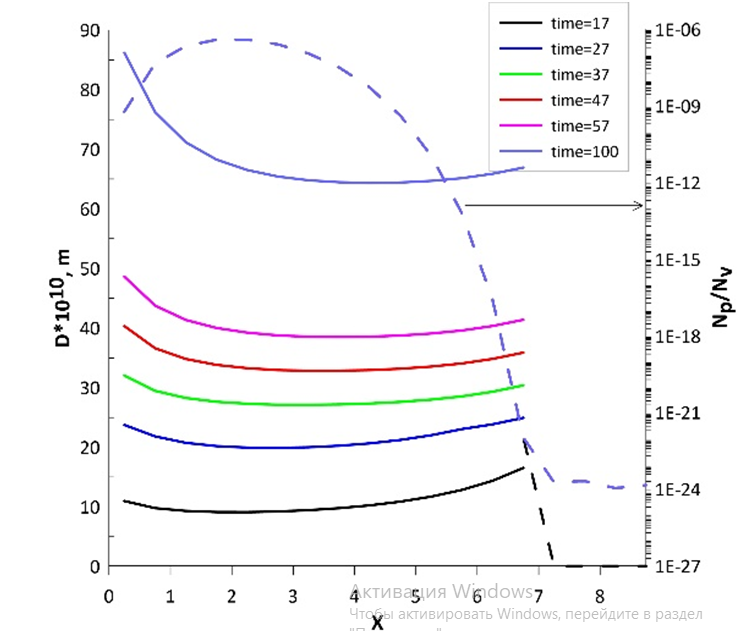
The results of this approach application are shown in Fig. 2. On this figure the data solutions problem of water evaporation from hot surface, which locates at coordinate \(x=\) 0, and condensation on cold surface (evaporation/condensation problem) at \(x=\) 50 are presented. The distance between hot and cold surface is 50 mean free paths of vapor molecules.
 |
 |
|---|---|
| (a) | (b) |
Figure 2. Dependences on coordinate for different moments of time: (a) particle sizes (solid lines) and degree of supersaturation (dashed lines); (b) particle sizes and \(N_{p}/N_{v}\) ratio (dashed lines, where \(N_{p}\) – droplet concentration, \(N_{v}\) – vapor molecule concentration)
The following approach has been used. At each time step, the degree of vapor supersaturation in the entire computational domain is calculated. The number of condensation centers is calculated using the well-known Frenkel–Zel'dovich formula (Kalikmanov, 2013) for the nucleation rate: \[\label{GrindEQ__1_} J_\text{CNT}=\beta\frac{\rho^2_v}{\rho_\text{liq}}\sqrt{\frac{2\sigma}{\pi m^3_1}}{\exp \left(\frac{W_{cr}}{k_BT}\right)}\text{,}\] where \(\beta\) – condensation coefficient, \(m_{1}\) – vapor molecule mass, \(\rho_{v}\) – vapor density, \(\rho_\text{liq}\) – liquid density, \(W_{cr}\) – work of formation of a drop of critical radius, \(\sigma\) – surface tension coefficient.
Figure 2(a) shows the time change of the particle diameters (left scale) and the degree of supersaturation (right scale) with time for a ratio of hot \(T_{w}\) and cold \(T_{0}\) surface temperatures equal to 1.1. The ratio of the densities corresponding to these temperatures along the saturation line is 4.3. It is clear from the figure that the diameter of the particles increases as a result of condensation on their surfaces, and the degree of supersaturation is lower when the condensation process is taken into account than when it is not. In Fig. 2(b) the dashed line indicates the ratio of liquid droplet concentration to vapor concentration. The analysis of Fig. 2 shows that although the number of droplets in the studied region is not large, these droplets lead to a decrease in the degree of supersaturation.
REFERENCES
Anisimov, S.I., Imas, Ya.A., Romanov, G.S., and Khodyko, Yu.V. (1970) Deistvie izlucheniya bol'shoi moshchnosti na metally, Moskow: Nauka (in Russian).
Frenclach, M. and Harris, S.J. (1987) Aerosol dynamics modeling using the method of moments, J. Colloid Interface Sci., 118(1): 252–261.
Hosseinizadeh, S.E., Ghamati, E., Jahangiri, A., Majidi, S., Khazaee, I., Aliabadi, M.A.F. (2023) Reduction of water droplets effects in steam turbine blade using multi-objective optimization of hot steam injection, Int. J. Therm. Sci., 187: 108155.
Hulburt, H.M. and Katz, S.M. (1964) Some problems in particle technology: a statistical mechanical formulation, Chem. Eng. Sci., 19(8): 555–574.
Kalikmanov, V.I. (2013) Nucleation Theory, Netherlands: Springer.
Kortsenshteyn, N.M., Petrov, L.V., Rudov, A.V., and Yastrebov, A.K. (2024) Bulk vapor condensation upon intensive evaporation from interfacial surface, Colloid J., 86(6): 912–921.
Kryukov, A.P., Levashov, V.Yu., Zhakhovskii, V.V., and Anisimov, S.I. (2021) Heat and mass transfer at condensate–vapor interfaces, Phys. Usp., 64(2): 109.
Kryukov, A.P., Levashov, V.Yu., and Shishkova, I.N. (2007) Evaporation-condensation problem in vapour-gas mixtures, in Proc. of 25th Int. Symp. on Rarefied Gas Dynamics, Novosibirsk, 1176–1181.
Labuntsov, D.A. and Kryukov, A.P. (1979) Analysis of intensive evaporation and condensation, Int. J. Heat Mass Transf., 22(7): 989–1002.
Levashov, V.Yu., Kryukov, A.P., and Shishkova, I.N. (2024) Influence of homogeneous nucleation on the intensity of evaporation/condensation processes, Colloid J., 86: 232–240.
Sidorov, A.A. and Yastrebov, A.K. (2021) Numerical simulation of the gas expansion process in a turboexpander unit by the finite volume method, Therm. Eng., 68(8): 604–611.
Zhakhovsky, V.V., Kryukov, A.P., Levashov, V.Yu., Shishkova, I.N., and Anisimov, S.I. (2019) Mass and heat transfer between evaporation and condensation surfaces: Atomistic simulation and solution of Boltzmann kinetic equation, Appl. Phys. Sci., 116(37): 18209–18217.
参考文献列表
- Anisimov, S.I., Imas, Ya.A., Romanov, G.S., and Khodyko, Yu.V. (1970) Deistvie izlucheniya bol'shoi moshchnosti na metally, Moskow: Nauka (in Russian).
- Frenclach, M. and Harris, S.J. (1987) Aerosol dynamics modeling using the method of moments, J. Colloid Interface Sci., 118(1): 252–261.
- Hosseinizadeh, S.E., Ghamati, E., Jahangiri, A., Majidi, S., Khazaee, I., Aliabadi, M.A.F. (2023) Reduction of water droplets effects in steam turbine blade using multi-objective optimization of hot steam injection, Int. J. Therm. Sci., 187: 108155.
- Hulburt, H.M. and Katz, S.M. (1964) Some problems in particle technology: a statistical mechanical formulation, Chem. Eng. Sci., 19(8): 555–574.
- Kalikmanov, V.I. (2013) Nucleation Theory, Netherlands: Springer.
- Kortsenshteyn, N.M., Petrov, L.V., Rudov, A.V., and Yastrebov, A.K. (2024) Bulk vapor condensation upon intensive evaporation from interfacial surface, Colloid J., 86(6): 912–921.
- Kryukov, A.P., Levashov, V.Yu., Zhakhovskii, V.V., and Anisimov, S.I. (2021) Heat and mass transfer at condensate–vapor interfaces, Phys. Usp., 64(2): 109.
- Kryukov, A.P., Levashov, V.Yu., and Shishkova, I.N. (2007) Evaporation-condensation problem in vapour-gas mixtures, in Proc. of 25th Int. Symp. on Rarefied Gas Dynamics, Novosibirsk, 1176–1181.
- Labuntsov, D.A. and Kryukov, A.P. (1979) Analysis of intensive evaporation and condensation, Int. J. Heat Mass Transf., 22(7): 989–1002.
- Levashov, V.Yu., Kryukov, A.P., and Shishkova, I.N. (2024) Influence of homogeneous nucleation on the intensity of evaporation/condensation processes, Colloid J., 86: 232–240.
- Sidorov, A.A. and Yastrebov, A.K. (2021) Numerical simulation of the gas expansion process in a turboexpander unit by the finite volume method, Therm. Eng., 68(8): 604–611.
- Zhakhovsky, V.V., Kryukov, A.P., Levashov, V.Yu., Shishkova, I.N., and Anisimov, S.I. (2019) Mass and heat transfer between evaporation and condensation surfaces: Atomistic simulation and solution of Boltzmann kinetic equation, Appl. Phys. Sci., 116(37): 18209–18217.