New Possibilities of Total Heat Flux Registration during Intensive Pulsed Gas-Dynamic Processes with High Temporal Resolution
Recent activities. Modern approaches to conducting pulsed gas dynamic studies make it possible to use new types of devices with the effect of thermoelectric power anisotropy to record large gradients of the total heat flux. One of such devices is the recently developed thermoelectric detector (Kotov et al., 2024), which is now finding increasing application in high-enthalpy experiments. Thus, in Kotov et al. (2021a), the heat flux behind a reflected low-intensity shock wave in nitrogen was measured. Simultaneous operation of sensors of different types [detector and gradient heat flux sensor (Sapozhnikov et al., 2020)] made it possible to determine a high degree of reliability of the detector readings under shock-wave interaction conditions. In Kotov et al. (2021b), sufficiently large values of heat fluxes (up to 50 MW/m2) were recorded in shock-heated xenon at shock wave Mach numbers up to M = 8. The sensors demonstrated such useful qualities as a high signal-to-noise ratio, fast response time and low inertia, and no need to use a signal amplifier.
The operating principle of the thermoelectric detector is based on the generation of thermal electromotive force (thermo EMF) in the sensitive layer of the sensor along the substrate due to the effect of the incoming heat flux. The sensitive layer itself is an inclined condensed film, which is formed by means of the procedure of vacuum oblique deposition – a multitude of crystalline conductive structures of angular orientation with contact resistance between them arise on the heat-conducting dielectric substrate. Free charged particles located in these structures, due to thermal motion, create a potential difference between the upper and lower boundaries of the layer, which is removed during the experiment. This approach allows generating thermoelectric power in times much less than a microsecond.
In experiments on ignition of combustible mixtures in a shock tube (Kotov et al., 2022, 2023a; Kozlov et al., 2024), it was possible to obtain a time history of changes in heat fluxes at high values of gas pressure behind the reflected shock wave (more than 30 atm). Due to the high time resolution of the detectors, it was possible to specify the delay times of self-ignition of propane- and propene-air mixtures and to show the prospects of using sensors for these purposes. If we compare this approach with recording the moment of passage of a shock wave using a pressure sensor and recording the onset of free radical emission using spectrophotometric methods (Petersen, 2009), then the use of thermoelectric detectors makes it possible to see detailed fluctuations in heat loads over short periods of time and more accurately record the early ignition of combustible mixtures.
Typical signals generated for pulse processes of different intensity in gaseous media are shown in Fig. 1. Lines 1 and 2 show heat flux registered by a thermoelectric detector behind a reflected shock wave in nitrogen and xenon with Mach numbers of 3 and 7, respectively. Different autoignition delays measured in a propane-air mixture behind a reflected shock wave are shown by lines 3 and 4. The growth of readings 1 and 2 to peak values after reflection of a shock wave from the end wall over a period of time of the order of 1 μs. The difference in the nature of the growth is due to processes occurring due to the growth of the energy of chaotic particle motion and thermal nonequilibrium of gaseous media. In the case of xenon (line 2) differences in signal growth is also excited electron states begin to form, radiation and ionization are observed leading to signal increase.
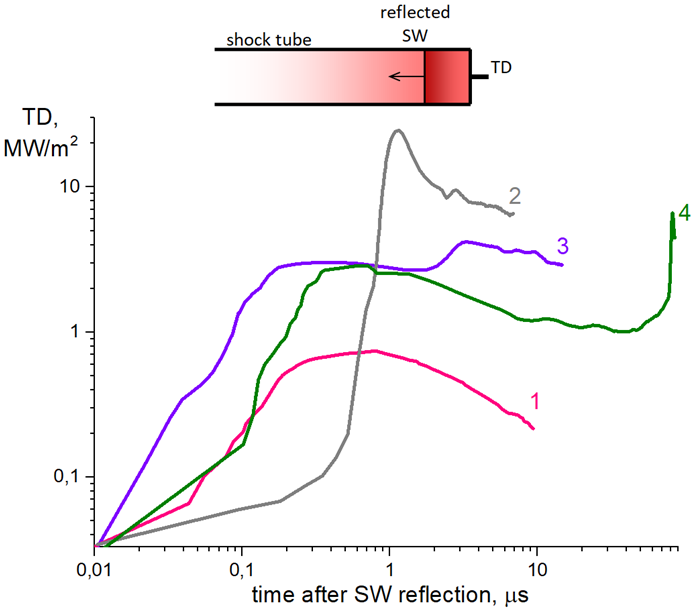
Figure 1. Signals generated by a thermoelectric detector (TD) in shock wave (SW) structures of varying intensity
The processes of spontaneous ignition behind the reflected shock wave occur due to the rapid increase in pressure and temperature of the combustible mixture. The delay of spontaneous ignition is a characteristic of the mixture and, in addition to the parameters indicated, also depends on the degree of stoichiometry (the ratio of fuel to oxidizer required for complete combustion). Lines 3 and 4 show the heat flux arising due to the arrival of the shock wave at the end wall of the shock tube (the first increase) and subsequent spontaneous ignition (the second increase) of propane-air mixtures with different stoichiometric coefficients.
Such data are unique and are of interest not only in terms of spontaneous ignition delay times data for combustible mixtures (especially at its low values), but also in terms of thermal loads data at high temperatures and pressures where most other sensors fail and cease to function.
The issue of the thermoelectric detector response to the radiative and convective components of the total heat flux is considered in Kotov et al. (2023b). It is shown that the sensor's sensitive element also successfully records the incoming radiation, and with an increase in the shock wave intensity, an increase in the contribution of radiative heat transfer to the total heat flux is observed.
The results obtained demonstrate the promise of using thermoelectric detectors in experiments in high-enthalpy pulsed gas-dynamic processes to record total and radiative heat fluxes with high temporal resolution.
REFERENCES
Kotov, M.A., Shemyakin, A.N., Solovyov, N.G., Yakimov, M.Yu., Glebov, V.N., Dubrova, G.A., Malyutin, A.M., Popov, P.A., Poniaev, S.A., Lapushkina, T.A., Monakhov, N.A., and Sakharov, V.A. (2021a) Performance Assessment of Thermoelectric Detector for Heat Flux Measurement behind a Reflected Shock of Low Intensity, Applied Thermal Engineering, 195: 117143.
Kotov, M.A., Shemyakin, A.N., Solovyov, N.G., Yakimov, M.Yu, Glebov, V.N., Dubrova, G.A., Malyutin, A.M., Popov, P.A., Poniaev, S.A., Lapushkina, T.A., Monakhov, N.A., and Sakharov, V.A. (2021b) The Analysis of Applicability of Thermoelectric Radiation Detectors for Heat Flux Measurements behind a Reflected Shock Wave, Journal of Physics: Conference Series, 2103: 012218.
Kotov, M.A., Kozlov, P.V., Gerasimov, G.Ya., Levashov, V.Yu., Shemyakin, A.N., Solovyov, N.G., Yakimov, M.Yu., Glebov, V.N., Dubrova, G.A., and Malyutin, A.M. (2022) Registration of Combustible Mixture Ignition in a Shock Tube with a Thermoelectric Detector, Russian Journal of Physical Chemistry B, 16(4): 655–660.
Kotov, M.A., Kozlov, P.V., Gerasimov, G.Ya., Levashov, V.Yu., Shemyakin, A.N., Solovyov, N.G., Yakimov, M.Yu., Glebov, V.N., Dubrova, G.A., and Malyutin, A.M. (2023a) Thermoelectric Detector Application for Measuring the Ignition Delay Time in a Shock Heated Combustible Mixture, Acta Astronautica, 204: 787–793.
Kotov, M.A., Kozlov, P.V., Levashov, V.Yu., Gerasimov, G.Ya., Solovyov, N.G., Shemyakin, A.N., Yakimov, M.Yu., Glebov, V.N., Dubrova, G.A., and Malyutin, A.M. (2023b) Registration of Radiative Heat Flux in a Shock Tube Using a Thermoelectric Detector, Technical Physics Letters, 49(9): 34–36.
Kotov, M.A., Solovyov, N.G., Shemyakin, A.N., Yakimov, M.Yu, Glebov, V.N., Dubrova, G.A., Malyutin, A.M., Popov, P.A., Poniaev, S.A., Monakhov, N.A., Lapushkina, T.A., Sakharov, V.A., Kozlov, P.V., Levashov, V.Yu., and Gerasimov, G.Ya. (2024) On the Principles of Thermo EMF Arise During Heat Flux Registration by a Thermoelectric Detector in a Pulse Gas Dynamic Experiment, Physical-Chemical Kinetics in Gas Dynamics, 25(3): 1–20.
Kozlov, P.V., Kotov, M.A., Gerasimov, G.Ya., Levashov, V.Yu., Bykova, N.G., and Zabelinskii, I.E. (2024) Experimental Study of the Ignition of a Stoichiometric Propylene–Oxygen–Argon Mixture Behind a Reflected Shock Wave, Russian Journal of Physical Chemistry B: 18(4): 1019–1024.
Petersen, E.L. (2009) Interpreting Endwall and Sidewall Measurements in Shock-Tube Ignition Studies, Combustion Science and Technology, 181(9): 1123–1144.
Sapozhnikov, S.Z., Mityakov, V.Yu., and Mityakov, A.V. (2020) Heatmetry: The Science and Practice of Heat Flux Measurement, Springer.
参考文献
- Kotov, M.A., Shemyakin, A.N., Solovyov, N.G., Yakimov, M.Yu., Glebov, V.N., Dubrova, G.A., Malyutin, A.M., Popov, P.A., Poniaev, S.A., Lapushkina, T.A., Monakhov, N.A., and Sakharov, V.A. (2021a) Performance Assessment of Thermoelectric Detector for Heat Flux Measurement behind a Reflected Shock of Low Intensity, Applied Thermal Engineering, 195: 117143.
- Kotov, M.A., Shemyakin, A.N., Solovyov, N.G., Yakimov, M.Yu, Glebov, V.N., Dubrova, G.A., Malyutin, A.M., Popov, P.A., Poniaev, S.A., Lapushkina, T.A., Monakhov, N.A., and Sakharov, V.A. (2021b) The Analysis of Applicability of Thermoelectric Radiation Detectors for Heat Flux Measurements behind a Reflected Shock Wave, Journal of Physics: Conference Series, 2103: 012218.
- Kotov, M.A., Kozlov, P.V., Gerasimov, G.Ya., Levashov, V.Yu., Shemyakin, A.N., Solovyov, N.G., Yakimov, M.Yu., Glebov, V.N., Dubrova, G.A., and Malyutin, A.M. (2022) Registration of Combustible Mixture Ignition in a Shock Tube with a Thermoelectric Detector, Russian Journal of Physical Chemistry B, 16(4): 655–660.
- Kotov, M.A., Kozlov, P.V., Gerasimov, G.Ya., Levashov, V.Yu., Shemyakin, A.N., Solovyov, N.G., Yakimov, M.Yu., Glebov, V.N., Dubrova, G.A., and Malyutin, A.M. (2023a) Thermoelectric Detector Application for Measuring the Ignition Delay Time in a Shock Heated Combustible Mixture, Acta Astronautica, 204: 787–793.
- Kotov, M.A., Kozlov, P.V., Levashov, V.Yu., Gerasimov, G.Ya., Solovyov, N.G., Shemyakin, A.N., Yakimov, M.Yu., Glebov, V.N., Dubrova, G.A., and Malyutin, A.M. (2023b) Registration of Radiative Heat Flux in a Shock Tube Using a Thermoelectric Detector, Technical Physics Letters, 49(9): 34–36.
- Kotov, M.A., Solovyov, N.G., Shemyakin, A.N., Yakimov, M.Yu, Glebov, V.N., Dubrova, G.A., Malyutin, A.M., Popov, P.A., Poniaev, S.A., Monakhov, N.A., Lapushkina, T.A., Sakharov, V.A., Kozlov, P.V., Levashov, V.Yu., and Gerasimov, G.Ya. (2024) On the Principles of Thermo EMF Arise During Heat Flux Registration by a Thermoelectric Detector in a Pulse Gas Dynamic Experiment, Physical-Chemical Kinetics in Gas Dynamics, 25(3): 1–20.
- Kozlov, P.V., Kotov, M.A., Gerasimov, G.Ya., Levashov, V.Yu., Bykova, N.G., and Zabelinskii, I.E. (2024) Experimental Study of the Ignition of a Stoichiometric Propylene–Oxygen–Argon Mixture Behind a Reflected Shock Wave, Russian Journal of Physical Chemistry B: 18(4): 1019–1024.
- Petersen, E.L. (2009) Interpreting Endwall and Sidewall Measurements in Shock-Tube Ignition Studies, Combustion Science and Technology, 181(9): 1123–1144.
- Sapozhnikov, S.Z., Mityakov, V.Yu., and Mityakov, A.V. (2020) Heatmetry: The Science and Practice of Heat Flux Measurement, Springer.