Oxidation of aluminum in water at high temperature
Aluminum has high thermal and electrical conductivity as well as resistance to corrosion due to the rapid formation of strong oxide films that protect the surface from further interaction. It is well known that aluminum metal can be stored for years, and it does not react with water under standard conditions (about 20°C and atmospheric pressure and without any additional chemical additives) (Shkolnikov et al., 2011). However, at high temperatures we can fully oxidize aluminum even in distilled water.
In our recent study, we demonstrated the possibility of oxidizing large (with a size of 1 cm) aluminum granules (Fig. 1) in water without any additional chemical additives (Ambaryan et al., 2023). The oxidation experiments were carried out at temperatures from 200 to 280°C. It was shown that after 10 hours at 280°C, granules of pure aluminum were almost fully oxidized. Moreover, it was shown that more chemically pure aluminum oxidizes much faster. At the same conditions (280°C and 10 hours), the conversion degree of aluminum with a chemical purity of 99.9% and 99.7% was less than 2%.
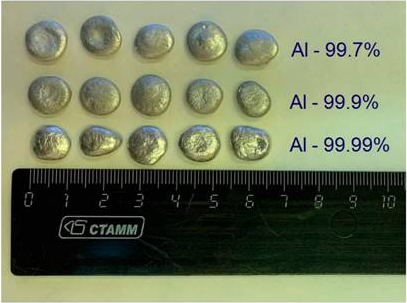
Figure 1. View of aluminum granules used in experiments. Aluminum of varying chemical purity was used: 99.7%, 99.9%, and 99.99%
The results of this study can be used not only in the development of operational recommendations for the use of aluminum, but also in the development of technologies using the reaction between aluminum and water.
The reaction between aluminum and water is realized in one of the following ways:
Al + 3H2O → 0,5Al2O3•3H2O + 1,5H2 + 427.98 kJ/mole,
Al + 2H2O → 0,5Al2O3•H2O + 1,5H2 + 415.24 kJ/mole,
Al + 1,5H2O → 0,5Al2O3 + 1,5H2 + 407.7 kJ/mole.
The properties of the products and their yield will be determined by the conditions of this reaction.
It can be seen that this reaction produces aluminum oxide or hydroxide and hydrogen, as well as outputs energy. So, the reaction between aluminum and water could be used where these products are needed. This could be an alumina-consuming plant, a hydrogen filling station, or a zero-emissions power plant.
Recently, we created a power plant fueled by aluminum (Vlaskin et al., 2011), which can produce hydrogen, useful electrical and thermal energy, as well as nanostructured aluminum hydroxide (Fig. 2). This power plant uses aluminum in powder form with a size of no more than 40 microns. Aluminum is continuously oxidized inside the reactor at temperatures of about 300–330°C. Only aluminum is used as a fuel and only water is used as an oxidizer, without any additional chemicals. Power plant outputs 15 kW of useful electricity or 10 m3/h of hydrogen. The power plant can operate autonomously, and its own power consumption is about 2 kW.

Figure 2. An experimental aluminum-fueled power plant. 1 – mixing tank, 2 – aluminum powder storage and dosage system, 3 – water dosage pump, 4 – distilled water tank, 5 – dosage high-pressure pump, 6 – reactor, 7 – variable cross-section valve, 8 – contactless level sensor, 9 – condenser, 10 – hydrogen dehumidifier, 11 – hotwells, 12 – heat exchanger, 13 – circuit water tank, 14 – circuit water pump, 15 – oxidation products receiving tank, 16 – hydrogen humidity sensor.
Aluminum hydroxide produced in aluminum-fueled power plant represents a powder with a crystal size of about 10–200 nm (Fig. 3). Its surface area is about 60–80 m2/g.
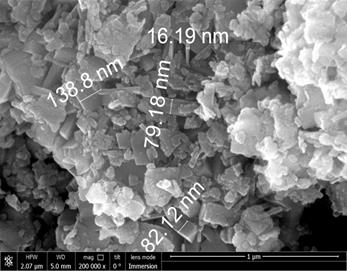
Figure 3. SEM image of aluminum hydroxide produced in aluminum-fueled power plant
Aluminum oxide and hydroxide obtained via aluminum oxidation in water can be used in different areas: from chemical industry to medicine. When pure aluminum is oxidized, we obtain pure alumina, which can be used to produce sapphires.
The oxidation reaction of aluminum in water still attracts the attention of researchers and developers, while work in this area continues. Further work should be devoted to the optimization of aluminum oxidation process. The main roadblock to energy production remains the transformation of the enthalpy of aluminum oxidation into usable energy. External combustion engines could use the enthalpy of aluminum oxidation. Hydrogen could be oxidized in situ or be utilized separately in internal combustion engine or fuel cell.
REFERENCES
Ambaryan, G.N., Buryakovskaya, O.A., Kumar, V., Valyano, G.E., Kiseleva, E.A., Grigorenko, A.V., and Vlaskin M.S. (2023) Hydrothermal oxidation of coarse aluminum granules with hydrogen and aluminum hydroxide production: The influence of aluminum purity, Applied Sciences, 13(13): 7793.
Shkolnikov, E.I., Zhuk, A.Z., and Vlaskin, M.S. (2011) Aluminum as energy carrier: Feasibility analysis and current technologies overview, Renewable and Sustainable Energy Reviews, 15(9): 4611–4623.
Vlaskin, M.S., Shkolnikov, E.I., Bersh, A.V., Zhuk, A.Z., Lisicyn, A.V., Sorokovikov, A.I., and Pankina, Y.V. (2011) An experimental aluminum-fueled power plant, Journal of Power Sources, 196(20): 8828–8835.
Referencias
- Ambaryan, G.N., Buryakovskaya, O.A., Kumar, V., Valyano, G.E., Kiseleva, E.A., Grigorenko, A.V., and Vlaskin M.S. (2023) Hydrothermal oxidation of coarse aluminum granules with hydrogen and aluminum hydroxide production: The influence of aluminum purity, Applied Sciences, 13(13): 7793.
- Shkolnikov, E.I., Zhuk, A.Z., and Vlaskin, M.S. (2011) Aluminum as energy carrier: Feasibility analysis and current technologies overview, Renewable and Sustainable Energy Reviews, 15(9): 4611–4623.
- Vlaskin, M.S., Shkolnikov, E.I., Bersh, A.V., Zhuk, A.Z., Lisicyn, A.V., Sorokovikov, A.I., and Pankina, Y.V. (2011) An experimental aluminum-fueled power plant, Journal of Power Sources, 196(20): 8828–8835.