Metal foam thickness effect on impinging round jets in channel
Abstract: This study investigates the effectiveness of jet impingement coupled with high-permeability metal foam for enhanced heat transfer. By employing porous media like aluminum foams, heat removal from heated surfaces is significantly improved. The research investigates into the thermal and fluid dynamic behaviors of this system, offering insights into its potential applications in electronic cooling and other engineering domains.
Keywords: impinging confined jets, porous media, channel partially filled
Jet impingement of a cold fluid is an efficient cooling method for a heated surface (Zing and Mahjoob, 2019). As indicated in the literature, jets employed together with porous media with high porosity and thermal conductivity, such as aluminum foams, allow for improved heat removal from a heated surface. The characteristics of jet impingement cooling through porous media are becoming important in many engineering applications, such as turbine blade internal cooling, electronic cooling systems, and solar collectors. Fundamental studies are needed to understand and characterize the thermal and fluid dynamic behaviors of this system. Hence, metallic foams employed as heat sinks in electronic cooling together with an impinging jet provide a very interesting solution to improve air convective heat transfer (Buonomo et al., 2015).
The effect of a high-permeability metal foam on heat transfer between a single round jet impinging on an opposite partially heated wall, as shown in Fig. 1, is investigated. The opposite wall to the air round jet is partially heated at a uniform heat flux.

Figure 1. Sketch of a system with a confined round jet in a channel partially filled with metal foam
The fluid flow in the channel is assumed to be two-dimensional, and the porous medium is modeled using the Brinkman-Forchheimer-extended Darcy model. The structure of the porous medium is homogeneous and isotropic, the thermophysical properties of the air and the porous medium are temperature-independent, and the fluid flow is steady-state, laminar, and incompressible. The analysis in the porous medium is accomplished under local thermal equilibrium conditions, and a two-dimensional numerical axisymmetric model is developed to evaluate the hydrodynamic and heat transfer characteristics within the channel. Moreover, the buoyancy effect is taken into account, whereas the radiation effect is neglected. The problem is solved employing the finite volume method with a commercial code, as pointed out in Buonomo et al. (2024).
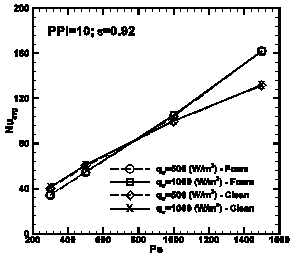
The effect on the heat transfer is shown in Fig. 2. In Fig. 2(a), the average Nusselt numbers are depicted for a porosity value of 0.92 and a pore density of 10 pores per inch. The Nu values for the clear cases are higher than those with metal foam for lower Pe values, up to about 800. For higher Pe values, the average Nusselt numbers for the cases with foam are greater than those for the clear cases. In Fig. 2(b), the average Nusselt number is given as a function of porosity for different pore densities and a fixed Peclet number. It is observed that for higher pore density, the value decreases with increasing porosity.
 |  |
| (a) | (b) |
Figure 2. Average Nusselt number as a function of: (a) Peclet number and (b) metal foam porosity
The main conclusions for impinging round jet in laminar flow in a channel partially filled with metal foam are that the addition of metal foam determines a decrease of the variations in terms of local values along the heated wall toward the flow. The average Nusselt number as a function of the Peclet number presents higher values for the cases without metal foam with respect to the cases with metal foam for lower Peclet numbers whereas the trend is opposite for higher Peclet numbers. The average Nusselt number for assigned pore density decreases increasing the porosity.
REFERENCES
Buonomo, B., Manca, O., and Nardini, S. (2015) Impinging jets in porous media, in K. Vafai, ed., Handbook of Porous Media-Third Edition, CRC Press, Chapter 19, 631–662.
Buonomo, B., Farinaro, M., Manca, O., and Nardini, S. (2024) A numerical study of the metal foam thickness effect on impinging round jets in channel partially filled with metal foam, in 9th Thermal and Fluids Engineering Conf. (TFEC), Partially online virtual and in person conference at Oregon State University, Corvallis, OR, USA, April, 21–24, 2024.
Zing, C. and Mahjoob, S. (2019) Thermal analysis of multijet impingement through porous media to design a confined heat management system, ASME J. Heat Transf. 141(8): 082203, https://doi.org/10.1115/1.4044008
References
- Buonomo, B., Manca, O., and Nardini, S. (2015) Impinging jets in porous media, in K. Vafai, ed., Handbook of Porous Media-Third Edition, CRC Press, Chapter 19, 631–662.
- Buonomo, B., Farinaro, M., Manca, O., and Nardini, S. (2024) A numerical study of the metal foam thickness effect on impinging round jets in channel partially filled with metal foam, in 9th Thermal and Fluids Engineering Conf. (TFEC), Partially online virtual and in person conference at Oregon State University, Corvallis, OR, USA, April, 21–24, 2024.
- Zing, C. and Mahjoob, S. (2019) Thermal analysis of multijet impingement through porous media to design a confined heat management system, ASME J. Heat Transf. 141(8): 082203, https://doi.org/10.1115/1.4044008